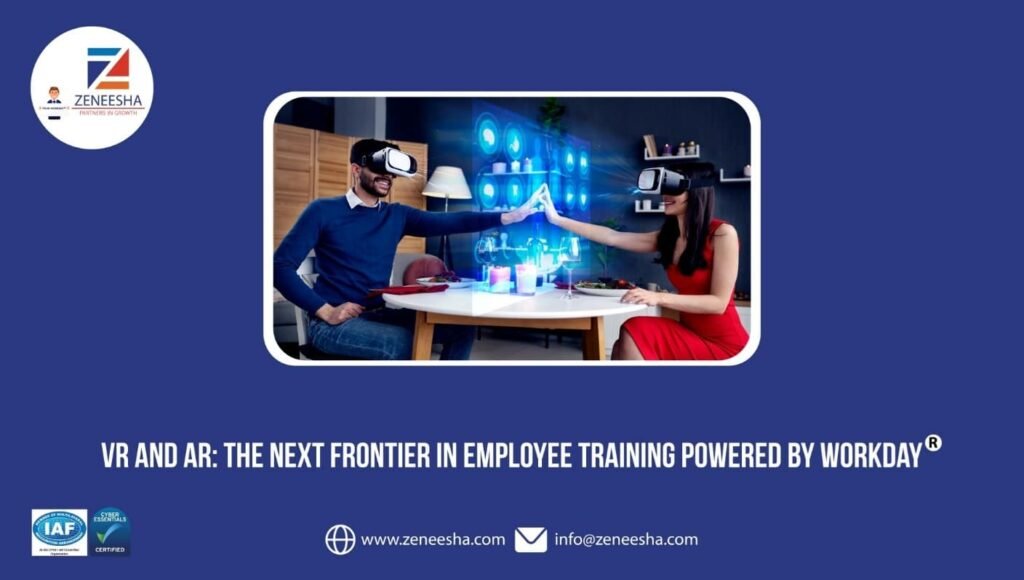
Virtual Reality (VR) and Augmented Reality (AR) are revolutionizing employee training by creating immersive and interactive learning experiences.
Here’s how they play a crucial role:
- Realistic Simulations: VR creates entirely immersive environments, allowing employees to experience situations that may be too dangerous, expensive, or impractical to replicate in real life. This is especially valuable in industries like manufacturing, healthcare, and aviation.
- Hands-On Learning: AR overlays digital information in the real world, enabling employees to interact with their physical environment while receiving digital guidance. This can be used for tasks like equipment maintenance, assembly procedures, or guided tours.
- Scenario-Based Learning: Both VR and AR allow for the creation of scenarios that mimic real-life situations. This helps employees practice decision-making and problem-solving in a safe, controlled environment.
- Reduced Training Costs: VR and AR can significantly reduce costs associated with traditional training methods. For example, companies can save on physical training facilities, travel expenses, and equipment costs.
- Customized Learning Paths: VR and AR systems can adapt to individual learning styles and paces. They can provide personalized feedback and content, ensuring that each employee receives the training they need to excel in their specific role.
- Improved Retention and Recall: Studies have shown that immersive learning experiences in VR and AR can lead to higher retention rates compared to traditional training methods. Employees are more likely to remember what they learned because of the realistic and memorable nature of the training.
- Global Collaboration: AR can facilitate real-time collaboration among teams located in different parts of the world. For example, technicians can receive guidance from experts who are remotely connected via AR-enabled smart glasses.
- Onboarding and Familiarization: VR can be used to create virtual tours of facilities, allowing new hires to become familiar with their workplace before they physically arrive. This can help reduce first-day jitters and improve the onboarding experience.
- Continuous Learning and Skill Development: VR and AR can support ongoing training and skill development, allowing employees to refresh their knowledge or learn new skills on demand.
- Accessibility and Inclusivity: VR and AR can be designed to accommodate various learning styles and abilities. For example, they can provide audio cues for those with visual impairments or offer multiple language options for global workforces.
- Complex Task Mastery: VR allows employees to practice complex tasks in a controlled environment. This is particularly valuable in fields like surgery, where precision and muscle memory are critical.
- Soft Skills Development: AR can be used to simulate social interactions, allowing employees to practice communication, conflict resolution, and customer service skills in a realistic setting.
- Crisis Management Training: VR can simulate emergency situations, providing employees with the opportunity to practice response protocols without putting them in actual danger.
- Language and Cultural Training: VR and AR can create virtual environments that mimic international settings. This is especially useful for employees who need to work across different languages and cultures.
- Feedback and Assessment: VR and AR systems can provide instant feedback on employee performance, allowing for immediate adjustments and improvements.
- Compliance and Safety Training: VR can simulate hazardous environments, ensuring employees are trained on safety protocols without exposing them to real-world risks.
- Remote Assistance and Troubleshooting: AR enables employees to receive real-time guidance from experts through smart glasses or mobile devices, allowing them to troubleshoot issues on the spot.
- Product Demonstrations and Sales Training: VR can create interactive product demos, allowing employees to familiarize themselves with offerings in a virtual showroom.
- Gamification of Learning: VR and AR can introduce gamification elements to training, making it more engaging and encouraging healthy competition among employees.
- Data Visualization and Analytics Training: AR can overlay real-time data onto physical objects, providing a dynamic and interactive way to learn about data analysis and interpretation.
- Psychological and Soft Skills Training: VR can simulate scenarios that help employees develop emotional intelligence, empathy, and other soft skills necessary for effective teamwork and leadership.
- Reducing Time to Proficiency: Immersive training experiences in VR and AR can accelerate the learning curve for new employees, enabling them to become proficient in their roles more quickly.
- Adaptive Learning Paths: VR and AR platforms can adjust the complexity and pace of training based on the individual learner’s progress, ensuring that each employee receives the right level of challenge.
Benefits of VR and AR integrated with Workday:
VR and AR technologies are reshaping employee training, and when integrated with platforms like Workday, the impact is even more profound.
Here’s how this synergy is shaping the future of workforce development:
- Immersive Onboarding: VR provides an immersive onboarding experience, allowing new hires to explore virtual replicas of office spaces, meet team members, and get a feel for the company culture, even before setting foot in the physical office.
- Virtual Simulations for High-Risk Professions: In fields like healthcare, aviation, and engineering, AR and VR can create lifelike simulations, enabling employees to practice complex procedures or scenarios in a safe and controlled environment.
- Role-Specific Training Modules: Workday’s analytics and data-driven insights can identify skill gaps within teams. VR and AR can then be used to create role-specific training modules that address these gaps, ensuring employees receive the precise training they need.
- Accessibility and Inclusivity: VR and AR can be tailored to accommodate different learning styles and abilities. For example, they can provide audio cues for those with visual impairments or offer multiple language options for global workforces.
- Enhanced Soft Skills Training: AR can simulate social interactions, allowing employees to practice communication, conflict resolution, and customer service skills in a realistic setting. This is particularly valuable in customer-facing roles.
- Continuous Learning in Virtual Labs: Workday’s learning management system can integrate with VR and AR platforms to offer employees access to virtual labs for ongoing skill development, where they can experiment, learn, and innovate in a risk-free environment.
- Scalable Training for Global Teams: VR and AR technologies enable organizations to deliver standardized training experiences to employees across different locations and time zones, ensuring consistency in learning outcomes.
- Rapid Prototyping and Product Development: In manufacturing or product development industries, AR and VR can be used to visualize and iterate on prototypes, saving time and resources compared to traditional physical prototyping.
- Interactive Compliance Training: VR can simulate hazardous environments for compliance training, ensuring employees are trained on safety protocols without exposing them to real-world risks.
- Gamification for Engagement: VR and AR can introduce gamification elements to training, making it more engaging and encouraging healthy competition among employees. Workday’s performance management module can track and reward progress.
- Real-time Performance Assessment: AR can provide instant feedback on employee performance during training sessions. Workday’s integration allows this data to be recorded for performance evaluations and development planning.
- Enhanced Product Knowledge: VR and AR can be used to create interactive product demonstrations and simulations. This empowers employees, especially in sales and customer service roles, with in-depth product knowledge for effective communication with customers.
- Crisis Management and Emergency Response Training: VR can simulate emergency situations, allowing employees to practice response protocols without putting them in actual danger. Workday can track and document employees’ completion of crisis training modules.
- Language and Cultural Immersion: AR and VR can create virtual environments that mimic international settings. This immersive experience helps employees adapt to different languages and cultures, especially in global organizations.
- Experiential Learning in Remote Work Settings: VR can be used to create virtual workspaces for remote employees. This facilitates experiential learning in a virtual office environment, helping employees adapt to the challenges of remote work.
- Accelerated Skill Acquisition: VR and AR can accelerate the acquisition of complex skills by providing a safe, repeatable environment for practice and skill-building. This is especially valuable in technical fields where precision is paramount.
- Adaptive Learning Paths: VR and AR systems can adjust the complexity and pace of training based on the individual learner’s progress. This ensures that each employee receives the right level of challenge, maximizing the effectiveness of training.
In conclusion, by integrating VR and AR into their training programs, organizations can create more engaging, effective, and memorable learning experiences for their employees, ultimately leading to improved performance and productivity. Additionally, by combining the capabilities of VR and AR with the data-driven insights of Workday, organizations can create a dynamic, immersive, and highly effective training environment. This not only accelerates the learning curve but also empowers employees to acquire and refine the skills needed to thrive in today’s rapidly evolving workplace.