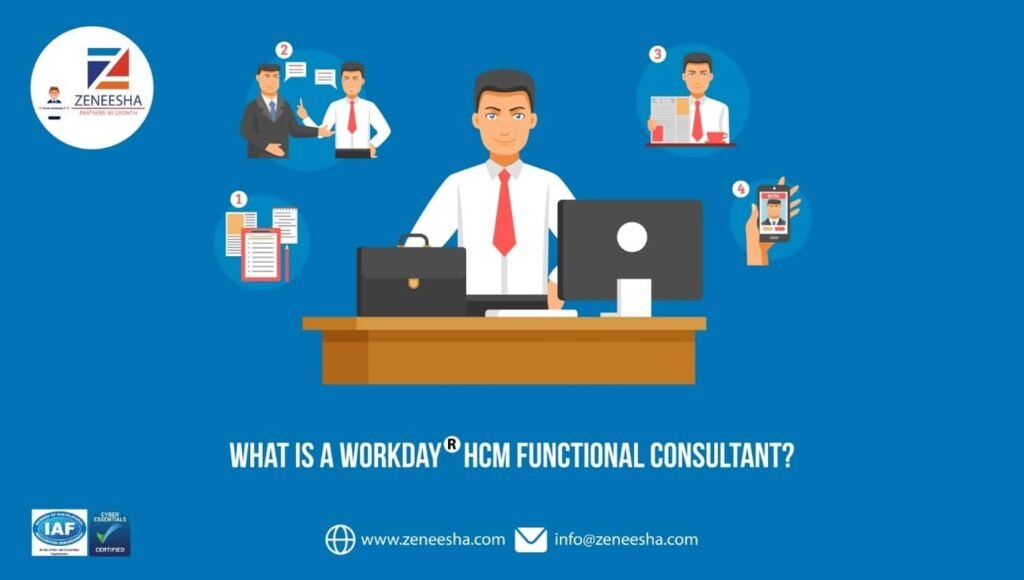
A specialist focusing on the use, setup, and optimization of Workday Human Capital Management (HCM) technology is known as a Workday HCM Functional Consultant. This platform offers features for payroll, time tracking, talent management, and human resources to enterprises.
The consultant is crucial to the initial system setup, integrating it with current software and tailoring it to the business’s specific needs. They oversee system updates, upkeep, troubleshooting, and deploying new features after implementation.
The consultant also develops plans for increasing system efficiency, teaches staff members, and offers continuing user support. They also carry out system testing, data analysis, and report preparation to assist management choices.
Workday HCM expertise, IT aptitude, project management skills, familiarity with HR procedures, and promising communication talents are required for this position. As a result, a Workday HCM Functional Consultant is essential to improving an organization’s HR operations.
1. Implementation and Configuration
The Workday HCM system is initially configured during the implementation stage to meet the enterprise’s specific requirements.
For this, the consultant must possess in-depth knowledge of Workday’s features and thorough expertise in human resource management.
The consultant collaborates closely with the business to develop a customized Workday HCM strategy that addresses payroll, benefits, recruitment procedures, talent management, workforce planning, and more issues.
Workflows, security roles, reports, and business processes must be created and modified when configuring the Workday HCM system.
The consultant ensures that features like management and employee self-service options, app integrations, and notification systems are correctly configured.
Effective configuration is essential because it enables the business to get the most out of the HCM system.
2. Maintenance & Upgrades
The Workday HCM system must be maintained continuously, which calls for constant evaluation and function optimization on the consultant’s part.
This involves controlling security parameters, fixing system flaws, instructing users, and implementing any required system modifications.
To find areas for improvement, routine maintenance also involves monitoring user feedback and system performance.
Upgrades are necessary to keep the Workday HCM system up to date and compatible with the evolving HR market.
The consultant’s job is to oversee and implement these system changes without causing any disruptions to the organization’s daily operations.
They evaluate these updates, implement them, and instruct users on the new functionality.
3. User Training & Support
An organization’s user base is guided by a Workday HCM Functional Consultant, who does more than build and maintain the program.
Practical user assistance and training are the foundation of every Workday HCM project that is a success.
As a result, educating staff members on how to use the system effectively is a sizable portion of the functional consultant’s job description.
The consultant develops user-friendly manuals, guides, and training materials during the initial system setup to aid staff in understanding the system.
They also hold training sessions to ensure that each user can efficiently utilize the new system.
After implementation, the consultant offers practical assistance to handle system-related problems and user inquiries.
They provide solutions that align with the organization’s operations and assist end users through individualized support.
Additionally, the consultant maintains a training cycle to keep everyone up to date on the capabilities of the system as new personnel are hired or when the system is updated.
Employees will be given the tools they need to use Workday HCM to its fullest potential, increasing productivity throughout the company.
4. Business Process Optimization
Business process optimization is a Workday HCM Functional Consultant’s essential task. The consultant creates, sets, and optimizes business processes to best meet the organization’s needs.
They evaluate the present HR procedures and suggest enhancements that will improve productivity.
They re-engineer business processes to increase accuracy, decrease redundancy, and boost overall scalability by utilizing Workday HCM’s best practices and cutting-edge capabilities.
The consultant also ensures that every set procedure complies with international HR legislation and aligns with Workday HCM capability. To achieve regulatory compliance, this entails ongoing assessment and audit.
5. System Analysis and Reporting
System analysis and reporting are among the various duties of a Workday HCM Functional Consultant.
To ensure the system is operating at peak efficiency and satisfying the company’s unique requirements, the consultant conducts routine evaluations and audits of it. They examine the system’s functioning and usability in-depth, gauging its effectiveness and finding potential problem areas.
Along with system analysis, the consultant is also responsible for producing thorough reports that offer insightful data on various HR indicators, including hiring status, employee performance, remuneration, benefits, and succession planning.
These reports provide a detailed picture of the organization’s human resources situation, empowering management to make wise decisions.
Workday HCM reporting can be altered, and the consultant takes advantage of this option to create reports uniquely tailored to the company’s requirements.
This can involve setting up automated messages that send out updates regularly, designing dashboards for real-time visualizations, or producing ad-hoc reports to meet particular requirements.
Due to the consultant’s proficiency in report configuration, all pertinent information is recorded and presented most effectively.
6. Skills/Qualifications Required
A Workday HCM Functional Consultant is a valuable asset to any company, requiring a particular set of abilities and credentials to carry out their duties well.
- Technical skills: It’s essential to have a thorough understanding of Workday HCM and all of its modules, including Payroll, Time Tracking, Benefits, and Human Resources. This calls for competence with the system’s implementation, configuration, and troubleshooting.
- Project Management Skills: Strong project management skills, including good task organization, prioritization, and execution, should be had by the consultant. It would be helpful to know about project management approaches like Agile.
- Analytical Skills: System analysis and reporting are vital elements in the position. The consultant must be able to evaluate system performance, spot problem areas, and put effective fixes in place. They should be competent with data analysis tools and be able to generate and analyze sophisticated HR reports.
- Communication Skills: Effective verbal and written communication skills are essential in a position that involves communicating with various stakeholders, from top management to regular users. The consultant must successfully convey intricate technical information in simple terms.
- Problem-Solving Skills: Technical difficulties and challenges are common in the workplace. A successful consultant should have strong problem-solving skills that enable them to identify and address system-related and user-related issues quickly.
- Adaptability and Continuous Learning: The HR technology industry is ever-changing, and consultants must keep up. This entails keeping up with recent technological developments, HR fads, and legislative changes.
- Educational requirements: A bachelor’s degree in computer science, information technology, human resources, or a related discipline is typically necessary. However, prior relevant work experience frequently serves as a supplement.
Conclusion
An expert who supervises the installation, upkeep, and update of the Workday Human Capital Management (HCM) system in a business is known as a Workday HCM Functional Consultant.
This person is essential to the HR strategy because they help the system be effective by ensuring it complies with the firm’s demands. The consultant’s competence includes system analysis, reporting, user assistance, and business process optimization.
They design a seamless system integration into the company by drawing on their in-depth knowledge of Workday’s features and sharp awareness of the HR sector. They use their analytical and problem-solving abilities to solve technical problems and enhance procedures.
A Workday HCM Functional Consultant is an essential tool in ensuring the efficient operation of an organization’s human capital management because of the wide range of their responsibilities. Their involvement significantly impacts how well HR operations are run, ultimately leading to overall corporate success.